News Updates

Project Update Third Quarter 2019: Mpindo Chapter Four
Many of you will have been following the story of the Mpindo pack, which has been featured in our newsletters since June 2018.
By Peter Blinston, Painted Dog Conservation Executive Director

The initial relocation of the Mpindo pack off communal lands in June 2018
Many of you will have been following the story of the Mpindo pack, which has been featured in our newsletters since June 2018. This small pack of just two adults (Snow Tail and Jonathan) and their pups have illustrated the challenges we face on the front line of conservation, where the pressure for space to live, leads to human-wildlife conflict situations that require mitigation and decisive action.
To recap: The Mpindo pack denned deep inside communal land in June 2018. The community responded very positively, tolerating the presence of the pack and the subsequent loss of livestock until we were able to capture them at the most opportune moment.

We housed the pack at our rehabilitation facility for six months before releasing the pack back into the wild. Unfortunately, it only took them a couple of months to find their way back in the same communal land. Our presence and dialouge with the communities again ensured that the dogs remained unharmed while we waited a few months for the best time to capture them.
This second capture was undertaken in June this year and we again housed the pack at our Rehabilitation Facility, while we now considered alternatives for their eventual release back into the wild.
And so, Chapter Four of the Mpindo “Dog’s life” unfolded recently.

Our work in Mana Pools and the wider Mid Zambezi Valley has been progressing steadily over the past ten years. In that time, we have seen the population steadily decline due to ageing alpha females, conflict with lions and hyenas, and possibly undesirable pressure from tourists, whose enthusiasm to see the painted dogs at times comes at a cost to the dogs.
This decline in the population is likely only a temporary situation, however, it presented us with an opportunity to find a new home for the Mpindo pack in a place far from human settlements. However, we needed help. Firstly, from Zimbabwe National Parks, who quickly issued the permits required to move the Mpindo pack and from our partners in the area, Wilderness Safaris. We knew the scale of the task ahead of us and knew that we needed a committed partner on the ground who could help us not only get the Mpindo safely to Mana Pools but also manage the ongoing logistical task of feeding them…… for atleast six months.

The holding boma in Mana Pools
The first task was to build an enclosure to hold them because we knew we could not just take the pack their and release them. All the wisdom pointed towards the need to hold the pack for six months or more in the area we hoped they would stay. Put simply, the longer we hold them in Mana Pools, the more likely they are to forget about their communal land home outside Hwange NP and accept that Mana Pools is their new home.
For this, we needed to find a site and construct an enclosure to hold them. Wilderness Safaris offered their camp infrastructure at their Chikwenya Camp, on the banks of the Zambezi River, and we gratefully accepted. Our team constructed the enclosure and during that process, we discussed all of the logistical needs with Wilderness Safaris for caring for the dogs until we were all happy that everything was in place.

The preparation for capture and move the Mpindo pack from our Rehabilitation Facility
Now we had to capture and move the dogs from our Rehabilitation Facility in Hwange to Mana Pools. I didn’t want to drive the 18 hours, on rough roads and asked Wilderness Safaris for a plane, which they provided without hesitation.

The capture of the Mpindo pack members
I knew the capture would be straightforward for us. It’s something we have done many times before and with appropriate planning, it’s not difficult. We set up capture nets in the enclosure adjacent to the one holding the dogs and then open the gate between the two. The dogs run through the gate and get caught up in the nets. We grab them, firmly but gently, covering their heads and quickly administer a tranquilising injection. There is no need to tranquilize the pups, they are small enough to just grab carefully.

"Old Pros" like Jealous and Washington, with new students and office staff like Maria, are all involved.

In this instance, we had the vets from Wildlife Vets International on hand, the veterinarian staff from our local government vet offices, as well as Dr Barbara Ferreira.

Wilderness Safaris’ plane ready to take the painted dogs to Mana Pools
Samples were taken and the dogs quickly processed through and put on the plane for the hour or so flight to Mana Pools.

The Mpindo pack in Chikwenya, Mana Pools
It was as smooth as could be. From the dogs being caught in the nets to being released into their new “home” at Chikwenya took just four hours.
Our team is in place in Mana to care for the dogs and Wilderness Safaris are providing all the support we need to ensure the dogs well being is taken care of and they are thus settling in well.
We will release them into Mana Pools in April 2020.

It's the support we receive from you that enable us to take on these seemingly impossible tasks without hesitation.
We can never thank you enough for your tireless commitment and support.

Project Update Third Quarter 2019: Changing Lives
This is a constant theme of ours.
By Peter Blinston, Painted Dog Conservation Executive Director

This is a constant theme of ours. We know it can and does make a difference. Be it a painted dog's life saved by the removal of a snare or a person inspired to change their life.

A once in a lifetime for many children is enough for them to go on and change the world. Certainly, our Iganyana Children's Bush Camp plays a vital role in this regard.

More than 800 children have attended our camp so far this year.

Project Update Third Quarter 2019: A War Against Poaching
Bring in the troops.
By Peter Blinston, Painted Dog Conservation Executive Director

Bring in the troops is an expression I have used before. It is literally the case as we continue to face the challenge of mitigating the threat of illegal hunting activities.

Lephias, on the left, has been recognised for his dedication and is the recipient of The Paradise Found African Ranger Award.
We have collected more than 2000 snares this year. Taking the total to well over 30,000 since we began this life-saving work in 2001.

Project Update Third Quarter 2019: The Threat of Rabies
Rabies is an ever-present threat to the painted dogs in our region.
By Peter Blinston, Painted Dog Conservation Executive Director
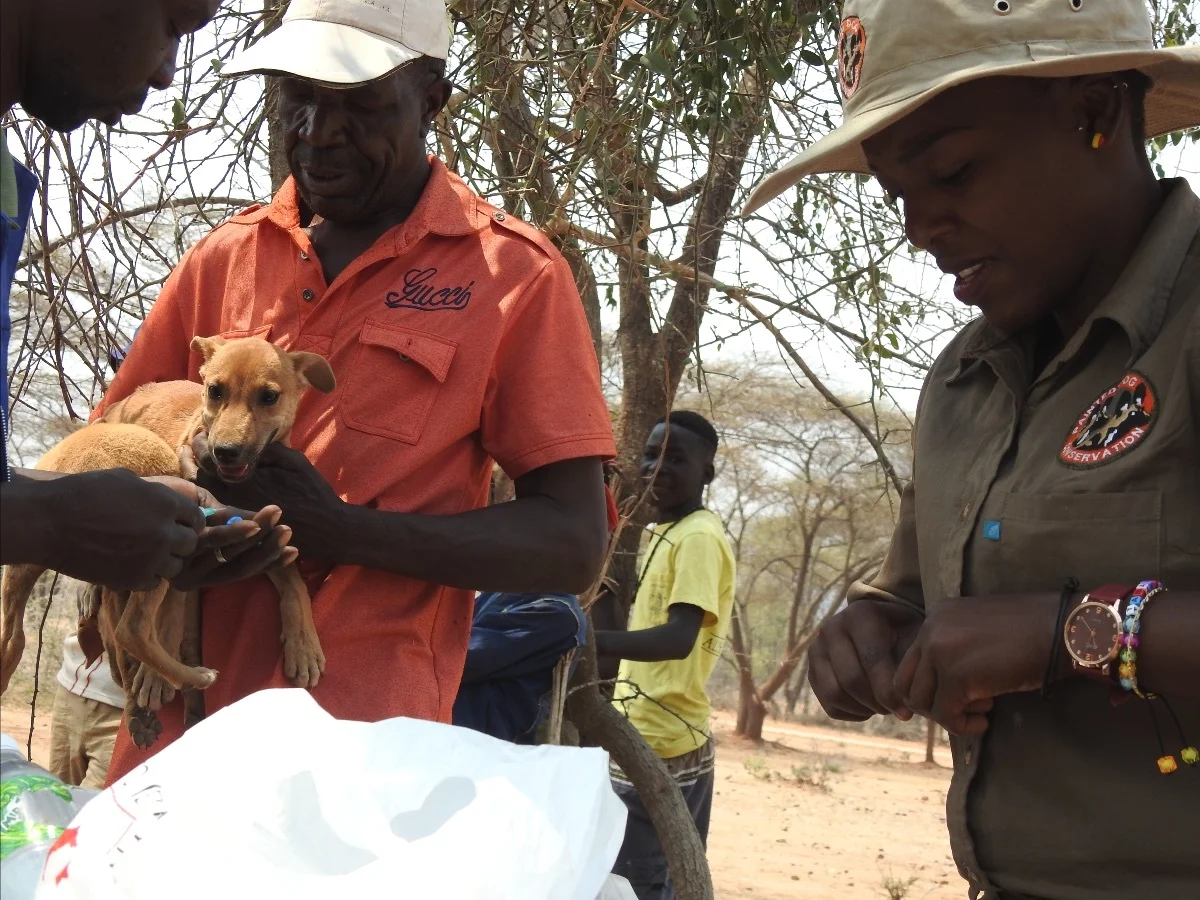
Rabies is an ever present threat to the painted dogs in our region. We suffered the loss of the Mabuyamabhema pack in 2017 and to help combat this we have stepped up our efforts to vaccinate as many domestic dogs against rabies (and distemper) in the surrounding villages.

We are supported in this vital work by Wildlife Vets International

Most importantly is the collaboration with our local Veterinary Department, who we also assisted recently with the donation of a solar system and refrigeration at their offices in near Dete.

During the campaign, we vaccinated more than 1500 domestic dogs.

The Legendary Browny has joined Socks
He was seen the morning of Sept 14th by PDC staff and they reported to me that he looked weak and struggling to keep up with Lucy and Lily, who stopped to wait for him. When I heard this I suspected that his time was nearly up. Nine is old for a painted dog.

©Will Burrard Lucas: Browny and Socks’ (his alpha female) pups in 2013 at the den.
It is with deep sorrow that we inform you about the death of Browny, a member of the Destiny pack and Sock's alpha male of the then Nyamandlovu pack. He was found dead on Sunday by our Executive Director, Peter Blinston. Browny was more than nine years old.
Below, Peter gives a detailed account of how he found Browny and the alpha's contribution to his kind over the years...
“He was seen the morning of Sept 14th by PDC staff and they reported to me that he looked weak and struggling to keep up with Lucy and Lily, who stopped to wait for him. When I heard this I suspected that his time was nearly up. Nine is old for a painted dog.

©PDC: Browny at 9 years old.
I drove out on Sunday afternoon to look for Browny, basing my search on 20 years of acquired knowledge and gut feelings. I started my search where he had been seen on Saturday morning and drove north towards Elephant Eye Safari Camp. As the road forked left towards Elephant Eye itself, instinct told me to go right. Right was right. I picked up the signal from Browny’s collar after approximately two kilometres. I drove towards the signal, knowing he was near the road or maybe on the road itself. The signal from his collar changed from resting (30bpm) to moving (45bpm). But his actual location did not change. Maybe he was lying down, irritated by mopane bees?
I drove as close as I could get to him and estimated he was still 500m off the road. I checked for the signals from Lucy and Lily, but there was none. Browny was on his own.
Without hesitation I drove in, manoeuvring my way around trees until I was really close. I knew Browny would not get up until I was right next to him because he has become so accustomed to our vehicles and dare I say he got to know us.
As I stepped out of my Land Rover I saw a hyena running away, approximately 150m in front of me, the same distance I estimated Browny to be “resting”. As I walked forward I could care less about the hyena, I knew, deep down, that Browny was dead. In my head, I kept repeating, “please, don’t let it be snare.” I’m sure I said it out loud as well.

©Will Burrard Lucas: Browny and his Nyamandlovu family
I walked up to what remained of Browny; the hyena must have been hungry. I estimated that he had died on Saturday morning, not long after our guys had seen him. It was fitting that PDC staff were the last people to see him alive and that I had found him. I loaded his remains into my car and drove him back to our Rehab, where he was buried alongside Socks. He had been her mate, father of 36 pups and grandfather to many more painted dogs that still roam Hwange NP and beyond. He had certainly played his sole in maintaining his kind and we already miss him.”